
Quick! Pop-quiz, hotshot: Where does the thesis go in your students’ essays?
Go ahead and answer out loud. The FBI agent watching you through your camera will let me know what you said. I’m kidding, of course, I don’t need Phil to tell me what you said. You said “End of the intro paragraph.”
Well done. That’s exactly right. Okay, let’s take the rest of the week off!

Oh, actually, sorry – just one quick follow-up question: Why?
Why does it go there?
Did you say, “Because… that’s, like, where it goes… It’s a rule. Maybe a law? I think it’s the 16th amendment to the Constitution?”*
Have you ever noticed when you teach and read published essays for examples of great writing they never… you know… look like the essays we teach our students to write?
Hands-down, no contest, the kind of thesis commonly taught – to the extent that most people think it’s the only kind – is the Closed-Form Thesis. It absolutely has a time and place. For example on an on-demand, timed essay for a standardized test. Or if someone is threatening to blow up a hospital unless you write a closed-form thesis.
I can’t think of anything else.
It’s closed-form because you’re locking yourself in to content and structure by announcing the 3 things you will prove in your essay. It strips writing of purpose, by forcing you to focus on real estate. Instead of arguing that Atticus Finch is a heroic character because he reflects the values to which our culture aspires, you argue that he’s a heroic character because he’s brave, honest, and stands up for what’s right. I’m already bored.
Some Alternatives:
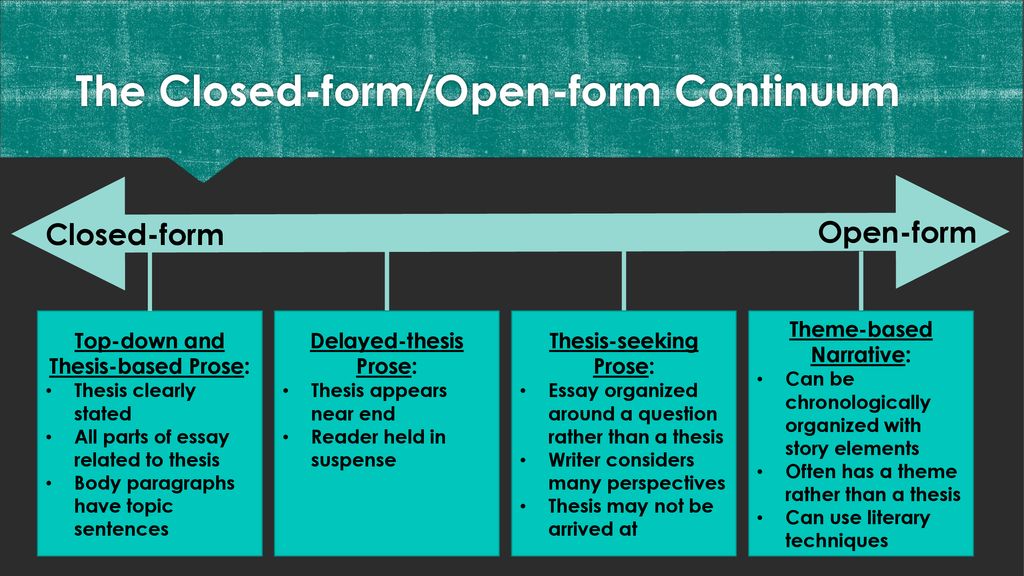
Delayed Thesis: Often you want to be clear up front what point you’re trying to prove. But sometimes it’s more effective to save that until the final paragraph.
- Purpose: Get the reader to absorb info w/o feeling trapped.
- Technique: Guide the reader to your conclusion.
- Audience: Those who are informed and/or who would disagree with your position
- Introduce the topic w/o stating thesis, rather proposing the issue or question
- Structure body to support your eventual thesis
- Conclude by finally stating thesis and connecting to the body of evidence
Implicit Thesis: This is as opposed to an explicit thesis, which is what we typically do. It is when you don’t even state your thesis, rather leave it for your audience to conclude on their own through the clarity and focus of your argument. Their power comes from the fact that they don’t exist until your audience creates them; they’re like the Tao Of Thesis Statements.** This may be the most effective form of thesis, and you want to be aware of it for analyzing writing, but we’re not going to focus on it for now, and it can be very challenging to teach. Very few students are there yet. Never mind. Forget I said anything. LOOK AWAY.
Open-Form Thesis: Here’s the one you’ll use most often. The open form thesis consists, in essence, of three things: A subject, an assertion about the subject, and the impact. It can be complex in its wording, but can be very simple, because any paper, any argument, ultimately attempt to prove one thing, and the open form thesis is focused on that central thing. It should then suggest how you’ll go about proving it, without overtly stating it.
Instead of listing your reasons, imagine you’re only allowed to give a single sense of why your thesis is true. how would you combine the list into one umbrella concept? Yes, this can be challenging at first.
For example:
- Closed-form thesis: Broadcast media plays too influential a role in criminal court trials because of their access to the people, their bias, and because of their need to sensationalize in order to generate ratings.
- Open-form: Broadcast media plays too influential a role in criminal court trials because of the tremendous power they wield to shape the narrative for their own purposes
Note how the open-form version sounds more like the way people talk. It also presents and intriguing idea – it “adds to the conversation” and gives me something to talk about, and you something to learn. Also, it doesn’t just lay everything out there – I can explore this in different ways, and you as a reader are going to learn more as you go. Finally, it does a far more effective job of setting a tone. The first one suggests, well, no tone. Just information. The second one suggests a conclusion on the subject, and a feeling about its impact.
Here’s a map*** of the continuum if it helps:
Here’s a handy chart for more information, “Open Form to Closed Form Writing Styles”
*It could be. You don’t know what the 16th Amendment is
** Sometimes these references are just for my own amusement. There’s no reason even a single one of you should know what I mean by the “tao of thesis statements”
***I was looking for an image for this page, and this image came up of open-form cellulose groups. And I think the 2nd and 3rd ones look like little guys falling over going “Oh oh oh!” and that just made me laugh and laugh


 The Byronic Man
September 14, 2023 at 5:32 am
Thank you, great tips!